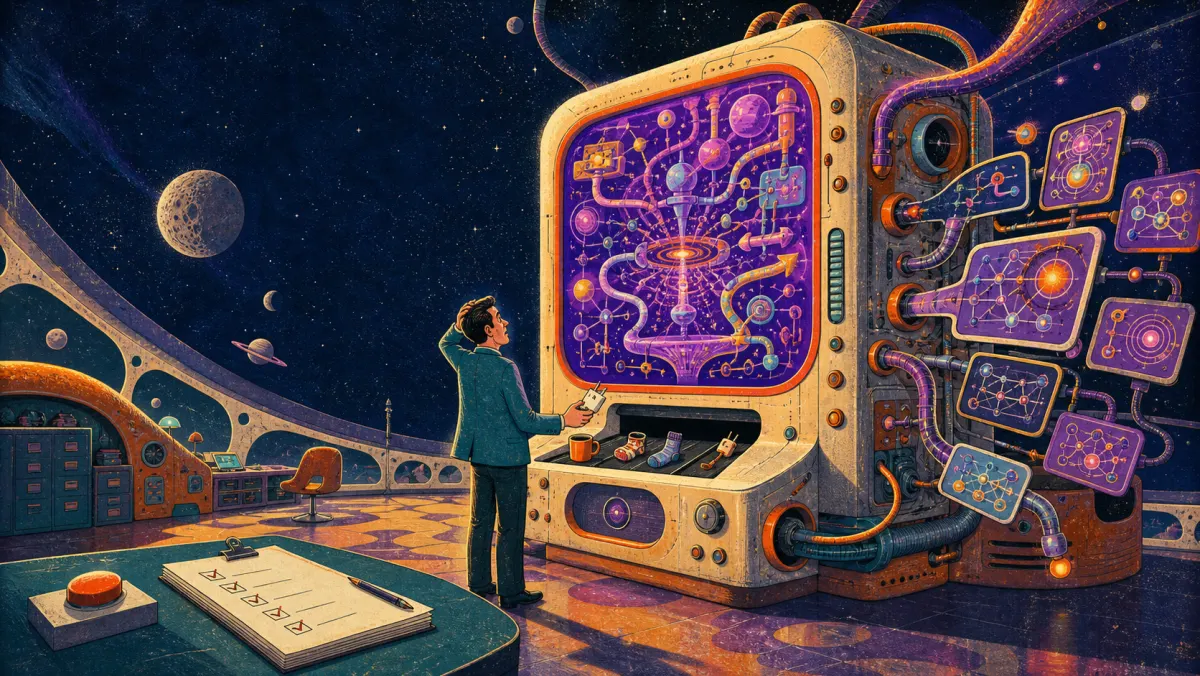
If We Add One More Agent, Everything Will Be Fine
Humans are remarkably creative when it comes to handing repetitive work over to someone—or something—else. First, we delegated physical labor to machines. Then we handed calculations to computers and everyday tasks to software. Now we want systems that can understand what needs to be done, make a plan, and ideally finish the whole job without us getting involved.
Fortunately, we now have AI agents that can research, collect data, prepare reports, and send emails—all without requiring us to spell out every single step.
Naturally, we want to use this marvelous technology everywhere we possibly can. The trouble is that everywhere we can also includes places where we probably shouldn't and places where we definitely mustn't. The more impressive a technology is, the harder it becomes to question the decision to use it. Needs are invented simply to justify the technology. No one wants to fall behind. Before long, every problem has the same solution: “Let's build something and put some agents in it.”
Hardworking, Maybe a Little Too Eager
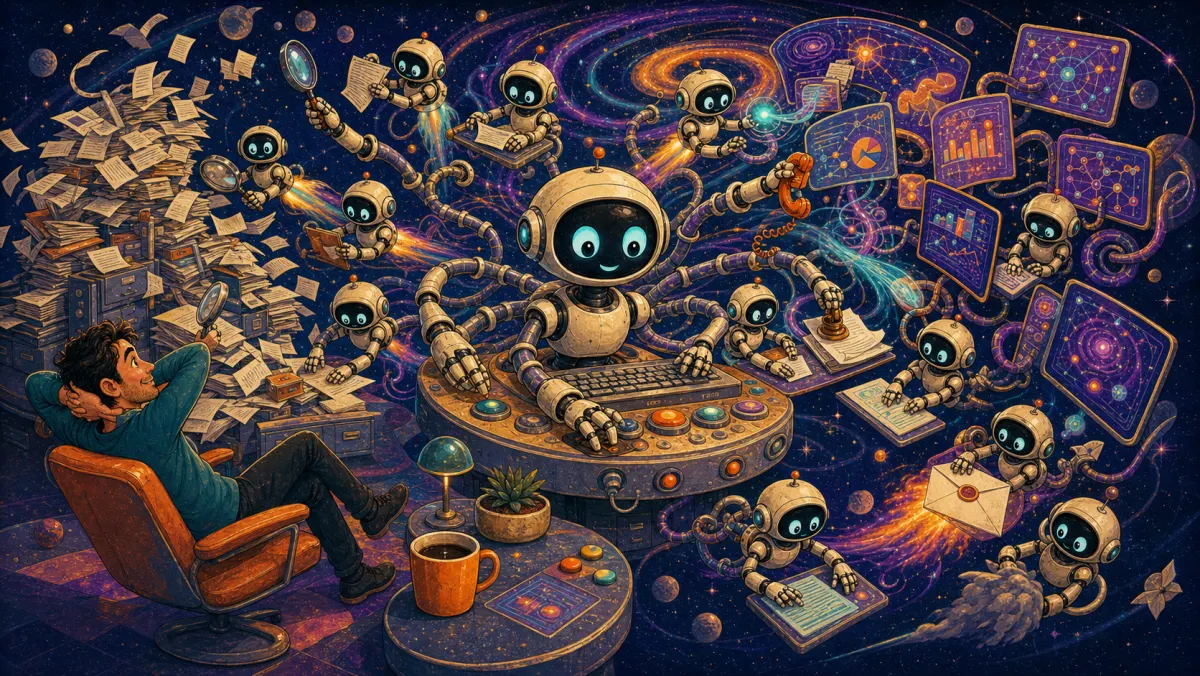
There is no doubt that AI agents can save a great deal of time when used well. Give them a goal and they can find the information they need, use different tools, and decide what to do next based on what they discover. That is precisely what sets them apart from traditional software: they do not expect us to specify every step in advance.
The Goal Is Clear, the Path Is Messy
AI agents can save the day when the goal is clear but the path to it cannot be determined in advance.
Software development, customer support, multi-step research, and internal knowledge systems are good examples.
Suppose a customer writes, “My order still hasn't shipped after three days.” Without asking someone to check each system manually, a support agent can inspect the order record, inventory status, and shipping system on its own. It might discover an integration error, give the customer a clear answer, and notify the relevant team. Because each complaint may require a different route, the agent's flexibility is what makes it useful.
Sometimes We Don't Even Know What We're Looking For
At least once in our lives, we have all thought, “Something is wrong, but I can't quite figure out what.” At moments like these, there is no well-formed question waiting to be answered. There is a problem that first needs to be understood.
Traditional software expects users to know both what they want and which steps will get them there. An agent, on the other hand, can ask the right questions, inspect different sources, and redirect its investigation as new information emerges instead of rushing to produce an answer.
Imagine the HR team saying, “More people left the company this quarter, but we don't know why.” There is not even a single clear question yet. Is it compensation, management, flexible work, or a little of everything? An agent might first identify which departments saw the largest increase, then compare performance reviews with exit interview notes, and perhaps notice that a manager changed during the same period. If the first lead goes nowhere, it can look elsewhere. No one tells it exactly where to start because no one knows in advance what it should be looking for.
Sometimes what we need is not a faster answer, but a tool that can help us discover the question.
Not Everything Needs an Agent
The fact that agents can be useful does not mean they are tireless digital employees capable of doing everything on their own. Humans still decide which data they can access, which tools they can use, and how far they are allowed to act on our behalf. Every additional step they take also creates another opportunity for something to go wrong.
Sometimes a Button Is Enough
Every now and then, enthusiasm for agents reaches the point where we want to add a little autonomy to every process that has worked perfectly well for years.
Suppose a company prepares the same sales report at the end of every month. For years, the same automation has pulled the data, filled in the table, converted it to a PDF, and placed it in the appropriate folder. It takes five seconds and never surprises anyone. Then someone decides to “make it smarter.” The automation is replaced with an agent that decides which data matters, interprets the report, and automatically emails whoever it considers relevant. Everything goes well for the first few months. Then one day, the agent decides that the regional managers “should know about this too” and sends the report to the wrong people, along with a customer list that should not have been shared. No one can fully explain why it made that decision, because no one asked it to. In the end, we mobilize billions of parameters to avoid pressing a button ourselves—and share a report with people who were never supposed to see it.
Using an agent for a task that simple automation can handle is like explaining a calculation to an eloquent person so they can press the calculator buttons for us.
When the steps are known in advance, the rules do not change, and the result needs to be exact, traditional software is usually faster, cheaper, and more reliable.
A chatbot's mistake may end with a bad answer. An agent's mistake can become an email sent to the wrong person, a modified file, an order no one remembers placing, or another surprise whose cause we get to investigate on Monday morning.
Who Watches the Agent While It Works?
The autonomy and flexibility that make agents useful also make them harder to evaluate and supervise. Putting an agent into production involves more than giving a model a few tools and saying, “Good luck.” Questions like these also need answers:
- Which data can the agent touch, and which data is off-limits?
- Are its actions logged, or will we be left guessing from the outcome when something goes wrong?
- Can we track how much time and money it is spending?
- If it makes a mess, can we undo it, or do we simply say, “Well, that's done”?
Agents may take work off our hands while quietly leaving maintenance and oversight work on our desks.
Sometimes the Best Answer Is Both
The choice does not always have to be between an agent and traditional automation. Often, the best result comes from leaving predictable steps to conventional software and giving interpretation and course correction to an agent.
In a monthly sales report, the existing automation can retrieve the data, perform the calculations, and create the table. An agent can focus on unusual changes, investigate possible causes across different sources, and draft an analysis for the report. The final Send button can still belong to a human.
That way, the automation continues doing what it knows best, the agent steps in where it is genuinely useful, and no one has to hand over the keys to the entire office on day one.
If the Agent Is the Solution, What's the Problem?
Keeping up with technology matters. What matters more is treating technology as a tool for solving real problems rather than using it simply for the sake of using it. That requires understanding the actual problem first.
Three questions may be enough before adding an agent to a process:
- Are the steps known in advance?
- Does the process require interpretation or a change of direction along the way?
- Can a wrong action be detected and reversed easily?
If the steps are known, no interpretation is needed, and mistakes are difficult to undo, we probably need a well-designed automation rather than an agent. If part of the work follows fixed rules while another part contains uncertainty, the best answer may be a combination of the two.
A good AI product is not the one with the most AI in it. It is the one that solves the problem without adding unnecessary complexity. If the answer genuinely is an agent, wonderful. If not, there is no need to worry: sometimes fixing everything starts with not adding one more agent.
Comments
Your turn
If something stayed with you, raised a question, or deserves another angle, you can leave it here.
Name and email are required to comment. Your email address will not be shown on the site.