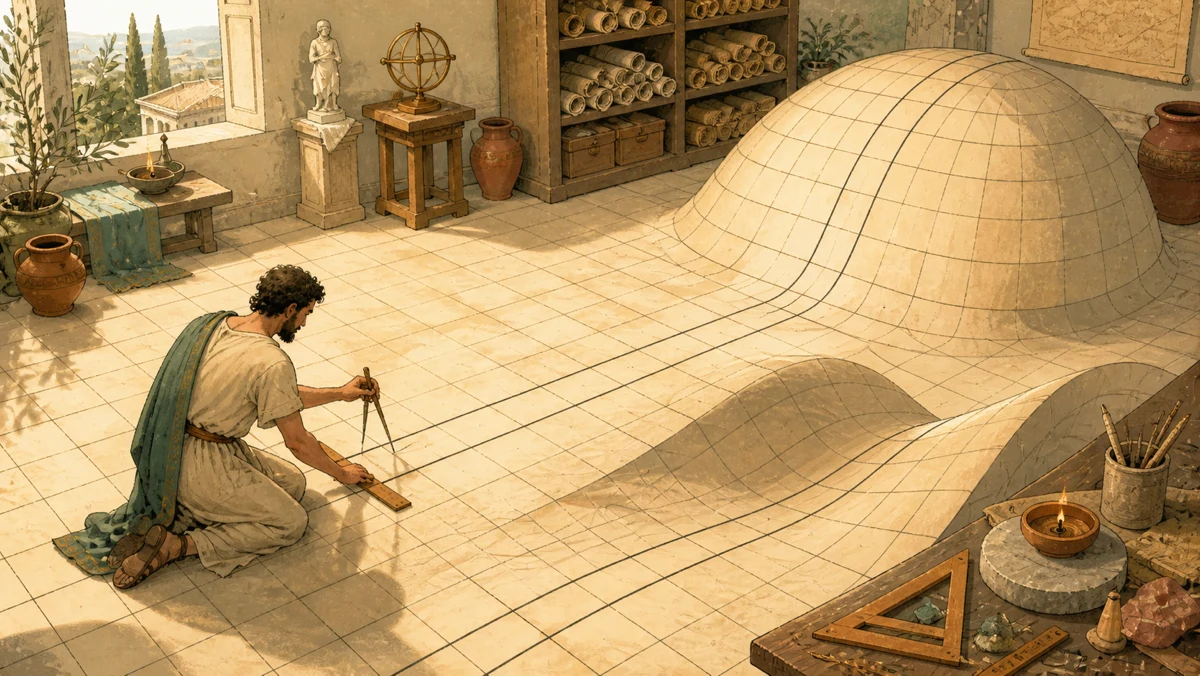
A 2,000-Year-Long ‘This Never Sat Right with Me’ Story
Mathematicians can be troubled even by things whose truth they never question. Euclid’s fifth postulate is one of the finest examples.
A very, very long time ago, Euclid laid the foundations of geometry with five postulates—fundamental assumptions accepted without proof. The first four were accepted without controversy. They seemed so natural that no one felt the need to give them a second look.
The fifth was different. It was longer and more complicated than the others, and somehow it felt less “fundamental” than a postulate ought to. Still, the whole of geometry worked perfectly well. The angles of a triangle continued to add up to 180 degrees, circles behaved like circles, and architects could build bridges. Nothing was actually wrong. It was just that... some mathematicians were bothered by the fifth postulate being there at all.
For centuries, they tried to show that the fifth postulate could be derived from the other assumptions of geometry. If they could prove it, everything would finally be in order. Geometry itself would not change, but mathematicians everywhere could breathe a sigh of relief. The only difference would be the discovery that Euclid had spent two thousand years carrying one postulate too many in his bag.
The fifth postulate, however, had other plans.
Euclid had left mathematicians with a small but remarkably long-lived problem. Nearly two thousand years later, someone did something rather dangerous.
They stopped trying to prove the fifth postulate.
They simply changed the question. It was no longer, “How can the fifth postulate be derived from the others?”
The question became:
“What if it can’t?”
And, as happens surprisingly often, this was precisely the point at which the history of mathematics became interesting.
Geometry’s User Manual
Euclid was a Greek mathematician from Alexandria who lived around 300 BCE. The details of his life have vanished into the cosmic darkness of history, leaving us with little more than the knowledge that he taught mathematics in Alexandria.
And that he was the father of geometry.
This title was not, of course, a “performance award” handed out in place of a raise after budget cuts at the Museum of Alexandria. Euclid earned it by organizing geometry into a general axiomatic system.
Today, a mathematical proof requires a modest serving of three basic ingredients:
- Defined and undefined objects: the undefined elements needed to start the system, such as points and lines, and the defined objects derived from them, such as triangles and circles.
- A postulate: an assumption about the relationships among those objects. For example, “There are at least two points on a line.”
- A proposition: the claim we are trying to prove.
Greek mathematicians had produced proofs before Euclid. But those proofs were scattered and largely independent of one another; there was no shared list of definitions and postulates on which everyone agreed. Euclid’s great achievement was to write these assumptions down explicitly and gather geometry into a coherent system.
He published this work in a book called the Elements, presumably written on papyrus with reed pens.
In Euclid’s time, geometry was closely intertwined with nature and philosophy. Perhaps under Plato’s influence, mathematicians regarded geometric forms as the counterparts of physical objects in the “World of Forms.” A stone may be round, but it is also rough, uneven, and misshapen. If we wanted to put it down on papyrus, and there were no suppressed artist inside us waiting to emerge, we would simply draw a circle.
For Euclid, then, a point or a line was not merely an artificial rule on which everyone had agreed. It was a description of one of these ideal objects that already existed in the mind. This is why, instead of leaving them undefined, he tried to describe them intuitively at the beginning of his book. A point, for instance, was defined as “that which has no part.”
He then listed the five famous postulates responsible for this entire article:
- A straight-line segment can be drawn from any point to any other point.
- A straight-line segment can be extended indefinitely in a straight line.
- A circle can be drawn with any centre and any radius.
- All right angles are equal to one another.
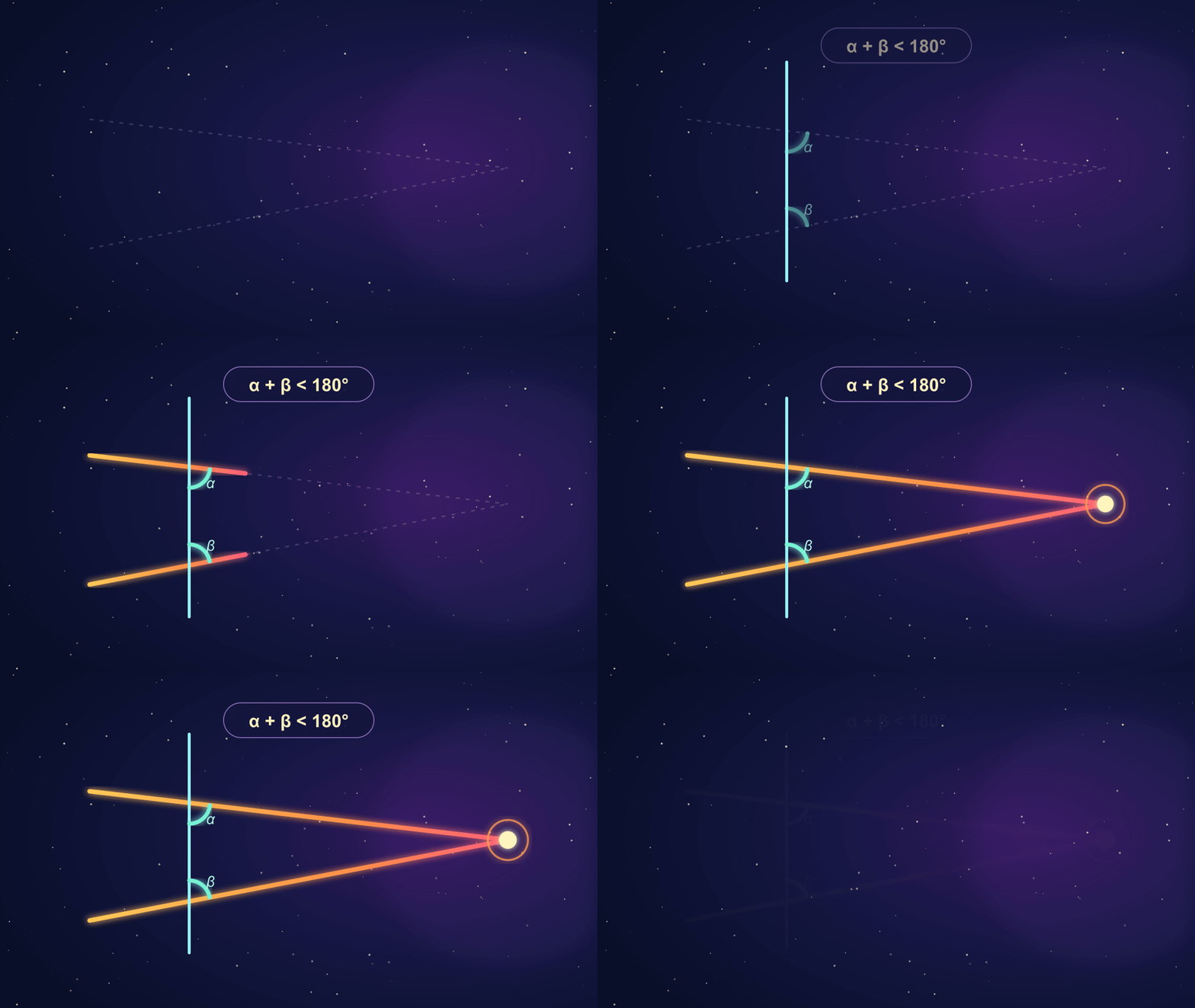
- If a straight line falling on two straight lines makes the interior angles on the same side less than two right angles, then the two straight lines, if extended indefinitely, meet on the side on which the angles are less than two right angles.
The first four postulates faced virtually no opposition. Papyrus was expensive, so mathematicians of the time probably worked on wax tablets or trays of sand, where they could readily see how naturally those assumptions fitted the ideal geometry they had in mind.
The fifth postulate was another matter. It sounded as though several simpler assumptions had been bundled together into something resembling a theorem. There had to be three lines; one had to cross the other two; the interior angles on one side had to add up to less than 180 degrees; then the two lines had to be extended. And if the sum was extremely close to 180 degrees but just slightly smaller, the lines might not meet until almost infinity. You cannot exactly draw an infinitely long line in a tray of sand. Compared with the others, the fifth postulate simply felt less natural.
The suggestion that Euclid himself was uncomfortable with it is based on the fact that he postponed using it until later in the Elements, proving the first 28 propositions without it.
No one doubted that the postulate was true. Geometry contained no contradiction, and the postulate was perfectly convincing to intuition. Surely, then, it had to be a theorem that could be proved from the other assumptions.
Attempts to prove the fifth postulate—or at least replace it with something simpler—continued for centuries.
A Centuries-Long Obsession
The first runner in this marathon whose attempt survives in the historical record was Ptolemy, appearing four centuries after Euclid. His “proof” did not generate much excitement. Ptolemy had first accepted the postulate in another form, then rearranged that disguised assumption until he arrived back at the postulate itself, creating a logical circle that went nowhere.
After Ptolemy in the second century came Proclus in the fifth, al-Jawhari in the ninth, Ibn al-Haytham in the tenth, and many others. In different ways, they repeatedly fell into the same trap: assuming some apparently obvious fact that was actually equivalent to the fifth postulate.
Omar Khayyam in the eleventh century—perhaps emboldened by wine and an independent mind—took the problem in a very different direction. He came tantalizingly close, but could not deliver the final blow. In the thirteenth century, Nasir al-Din al-Tusi once again reversed the game: instead of trying to prove the fifth postulate directly, he examined what would follow from alternative assumptions and looked for a logical contradiction.
As al-Tusi’s work reached the West, Europeans joined the caravan. In the seventeenth century, John Wallis claimed to have found the solution, without realizing that he too had stepped into the same logical circle.
A simpler statement equivalent to the fifth postulate would later become associated with John Playfair: “Given a line and a point not on it, exactly one line can be drawn through the point parallel to the given line.” This is known as Playfair’s axiom.
The Italian Jesuit priest Giovanni Girolamo Saccheri turned this question into a formidable weapon. In 1733, he published a book with the wonderfully confident title Euclid Freed of Every Flaw.
Saccheri’s actual alternatives concerned whether the two summit angles of what is now called a Saccheri quadrilateral were right, obtuse, or acute. Translated—somewhat roughly—into the modern language of parallels, three possibilities were on the table:
- Scenario A: Exactly one parallel passes through a point outside a given line. The traditional Euclidean world.
- Scenario B: No parallel passes through a point outside a given line.
- Scenario C: More than one parallel passes through a point outside a given line.
His aim was to demonstrate how absurd scenarios B and C were, leaving A—and therefore Euclid—as the only possible choice. Scenario B gave way quickly under the additional Euclidean assumptions Saccheri retained. But when he reached scenario C, things got out of hand. Saccheri derived page after page of theorems in this strange world with multiple parallels. The results looked nothing like ordinary geometry, yet they remained surprisingly consistent with one another. Saccheri had been searching for a contradiction; instead, he found the first traces of a new geometry.
Saccheri’s goal, however, was not to create a new geometry. It was to prove that Euclid’s fifth postulate was indispensable. So he interpreted his strange results not as a discovery, but as evidence that a false assumption was becoming increasingly absurd. Saccheri had found the door to a new geometry. But instead of opening it and finding another room, he tried to prove that the door was really a wall.
Messing with Geometry’s Settings
Between Saccheri’s death and Gauss’s arrival in the early nineteenth century, a quiet but enormous intellectual transformation was taking place in mathematics.
The study of geometric shapes and surfaces no longer depended solely on our ability to draw them. Geometric relationships could also be expressed through equations, and abstraction was gradually taking the place of the drawing. Geometry was becoming algebraic.
It was also becoming harder to dismiss the question of whether postulates were indisputable truths supplied by nature or assumptions chosen to initiate a mathematical system. Perhaps changing a postulate did not have to make the whole system collapse. Perhaps it merely produced another geometry governed by different rules.
It was in the middle of this storm that Gauss began swimming into dangerous waters. He dared to consider that a completely new system of geometry could be built even if the fifth postulate did not hold.
But he did not quite dare to say so.
Gauss understood how radical the idea was. For centuries, Euclidean geometry had been accepted as the one true geometry of the universe we inhabited. To suggest that other geometries were possible—at a time when Immanuel Kant, a towering intellectual authority, regarded Euclidean geometry as a necessary and a priori form of human spatial intuition—was to invite controversy.
And so, as someone who shares Gauss’s dislike of arguments and disturbances to personal comfort, I feel infinite sympathy for his decision to think, “Why ruin a perfectly good day?” and whisper his ideas only to those closest to him.
The Ending Nobody Expected
Once conditions are ready for an idea, however, it tends to occur to more than one mathematician.
While Gauss whispered his thoughts to his closest correspondents, two mathematicians at opposite ends of Europe began swimming through the same dangerous waters, independently of one another. In Russia, Nikolai Lobachevsky, and in Hungary, János Bolyai, assumed that the fifth postulate did not hold and opened the door to a very different universe.
In this universe, infinitely many lines could pass through a point outside a given line without meeting it, and the interior angles of a triangle added up to less than 180 degrees. In fact, for triangles whose vertices receded toward infinity, the total could be made arbitrarily close to zero.
Living in such a universe would be much stranger than seeing these results on paper.
If light obeyed the rules of this new geometry, depth perception would be turned inside out. A friend who looked perfectly normal beside you could seem to shrink as though falling over an invisible cliff after walking only a short distance away. Looking down a straight corridor, you might see its far end open outward like an enormous funnel instead of narrowing toward a vanishing point.
All of this might be enough to make a human lose their mind. Geometry could not have cared less.
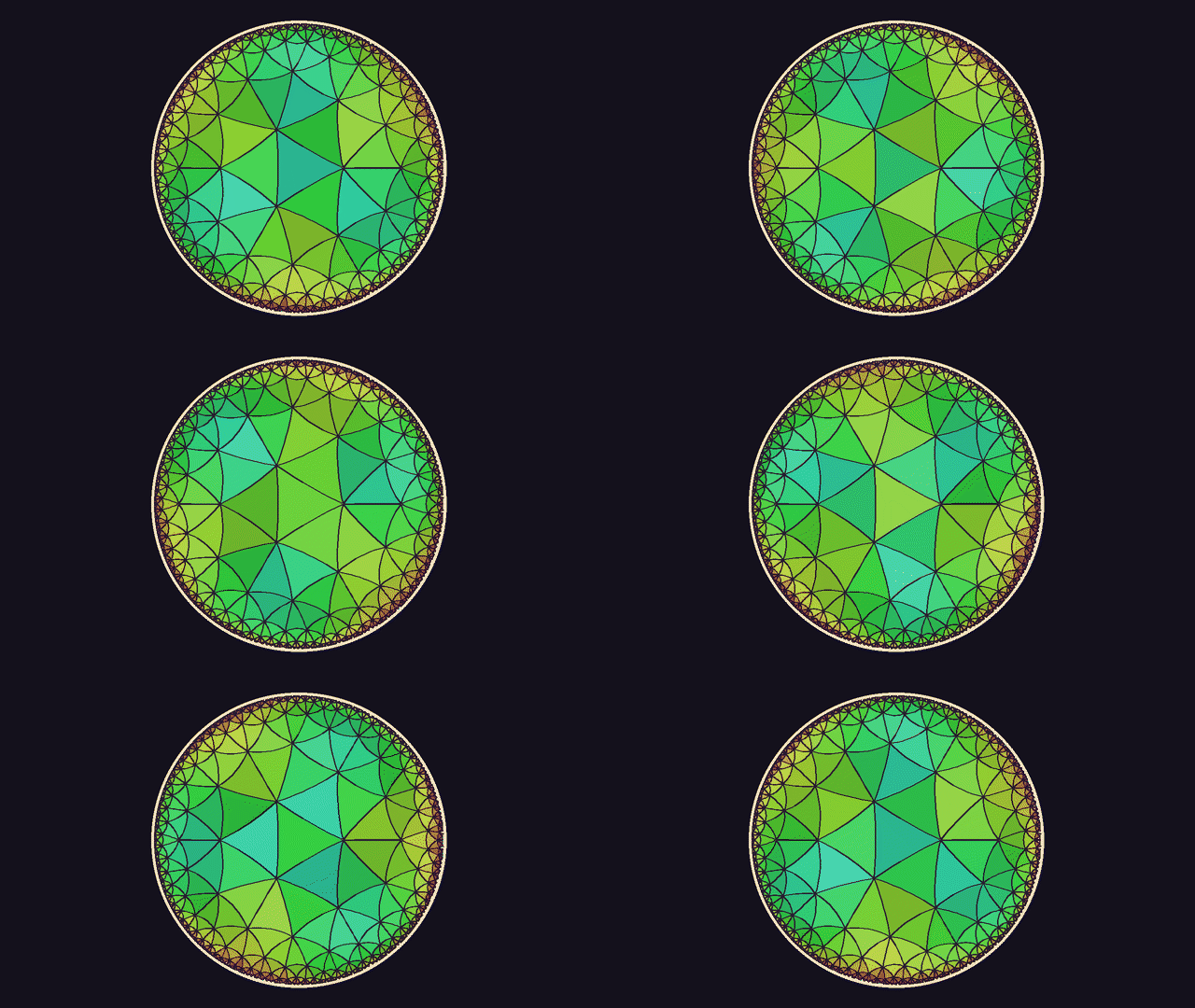
The fact that this strange geometry—now called hyperbolic geometry—had not yet produced a contradiction did not guarantee that it would remain so well behaved. Perhaps the contradiction was still hiding somewhere no one had managed to reach.
Then, in 1868, Beltrami constructed a model of hyperbolic geometry within Euclidean geometry. This meant:
If hyperbolic geometry contains a contradiction, then Euclidean geometry contains one too.
And with that, the two-thousand-year attempt to derive the fifth postulate from the other assumptions finally came to an end.
And the Story Continued
Saccheri had placed three possibilities on the table. In modern terms, scenarios A and C corresponded to Euclidean and hyperbolic geometry.
But what about scenario B? What if no parallel passed through a point outside a given line?
When Saccheri accepted the assumption corresponding to scenario B, he quickly found that it conflicted with the other Euclidean assumptions he had retained and discarded it. Mathematicians were now comparatively free in their choice of postulates, however, and no longer so reluctant to alter those other assumptions as well.
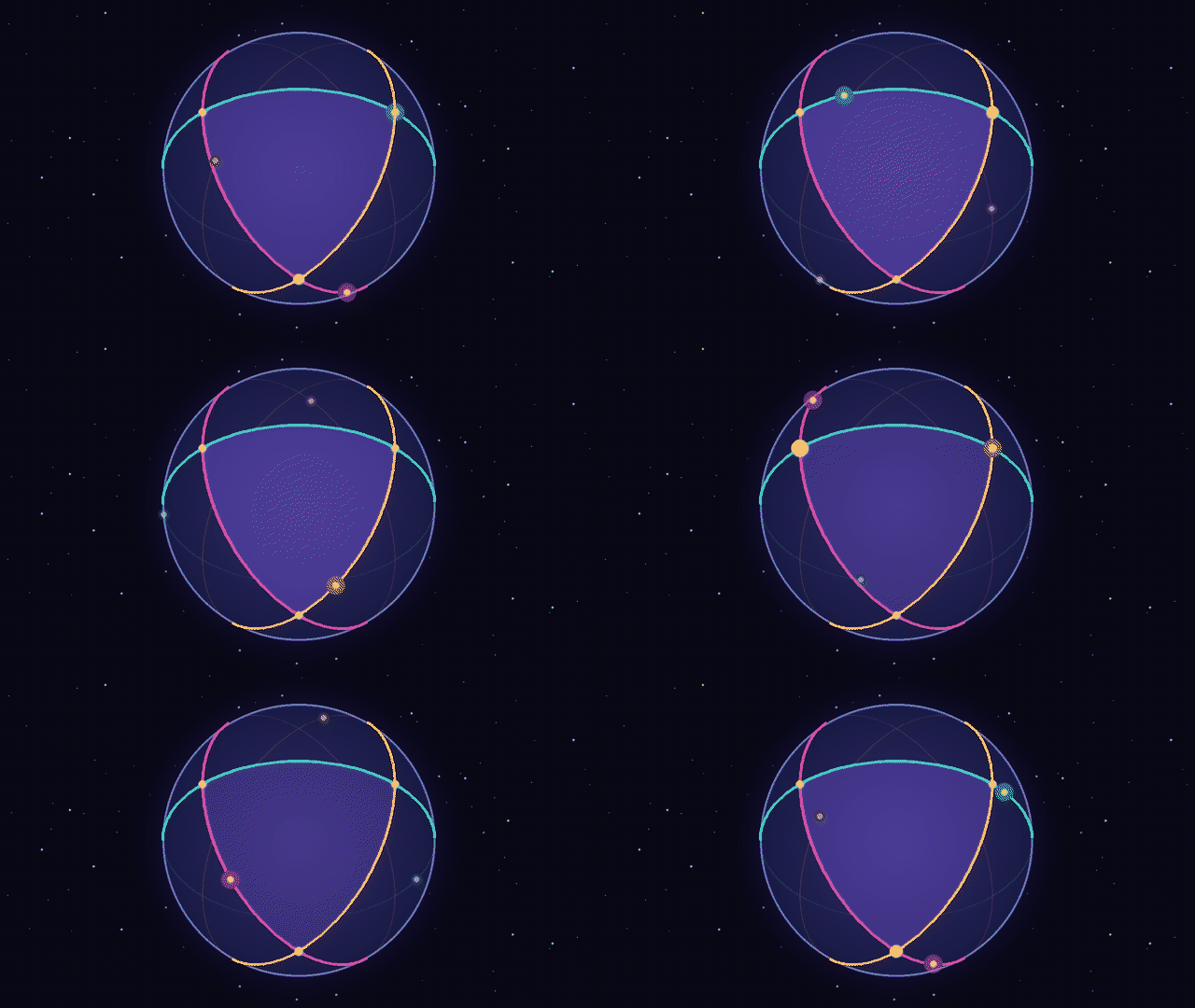
An entirely different geometry emerged. In this geometry, lines did not escape toward infinity. They closed back on themselves and returned to where they had started. Every pair of lines intersected, leaving no room for parallels. The interior angles of a triangle always added up to more than 180 degrees. Triangles with three right angles were perfectly possible.
Living in a universe with this geometry would produce a very different kind of vertigo. You could keep walking perfectly straight, never encounter a wall, and eventually return to where you began. If light obeyed the same geometry, the distant person you saw ahead might not be someone standing in front of you at all, but your own back after its light had travelled all the way around space and returned to your eyes. Look far enough into the sky and you might see the same star in several directions—or perhaps even see your own past. The universe would have no edge, but neither would it contain an infinite distance in which you could lose yourself.
Mathematicians called a geometry with these properties elliptic geometry.
To model elliptic geometry on a sphere, antipodal points—points on exactly opposite sides of the sphere—are identified as a single point. Great circles then become elliptic lines, and every two lines intersect at exactly one point.
The Geometry Right Before Their Eyes
While researching this story, I found myself more intrigued by another question than by the fifth postulate itself.
Curved surfaces have existed throughout human history. Why did history move from postulate to geometry rather than in the opposite direction? Why did mathematicians not discover different geometries by studying those curved surfaces and then connect them to Euclid’s fifth postulate?
An example of an alternative geometry was quite literally beneath their feet. So why did it take two thousand years to see it?
After asking all these questions, I realized that I had been looking at the past through the lenses of the present.
Classical mathematicians studied the sphere as part of the Euclidean space surrounding it. For them, space itself was not curved; the sphere sitting inside it was. The difficult part was not knowing that spheres existed. It was imagining that a space could, like the surface of a sphere, be curved in its own right.
Perhaps being right before our eyes is not enough for an idea to be discovered. We must also be willing to question the truths we have inherited.
For two thousand years, mathematicians failed to prove the fifth postulate. But that failure was not wasted. Every flawed proof, every fruitless attempt, and every “something about this doesn’t sit right” changed the question a little more.
Until someone stopped asking:
“How can we prove it?”
And asked instead:
“What if it can’t be proved?”
References
- *Euclid’s Elements* — Ali Sinan Sertöz
- *Euclid’s Window* — Leonard Mlodinow
- *A History of Mathematics* — Florian Cajori
- https://mathshistory.st-andrews.ac.uk/HistTopics/Non-Euclidean_geometry/
- https://www.cut-the-knot.org/triangle/pythpar/Attempts.shtml
Comments
Your turn
If something stayed with you, raised a question, or deserves another angle, you can leave it here.
Name and email are required to comment. Your email address will not be shown on the site.