The Unfortunate Identity Crisis of 1
The number seemed like a remarkably strong candidate for admission to the aristocratic club of primes. Yet despite all its persistence, its relationship with the club was not all that different from Turkey’s relationship with the European Union: it spent a very long time on the doorstep, only for the negotiations to end before it ever crossed the threshold.
Starting One Short
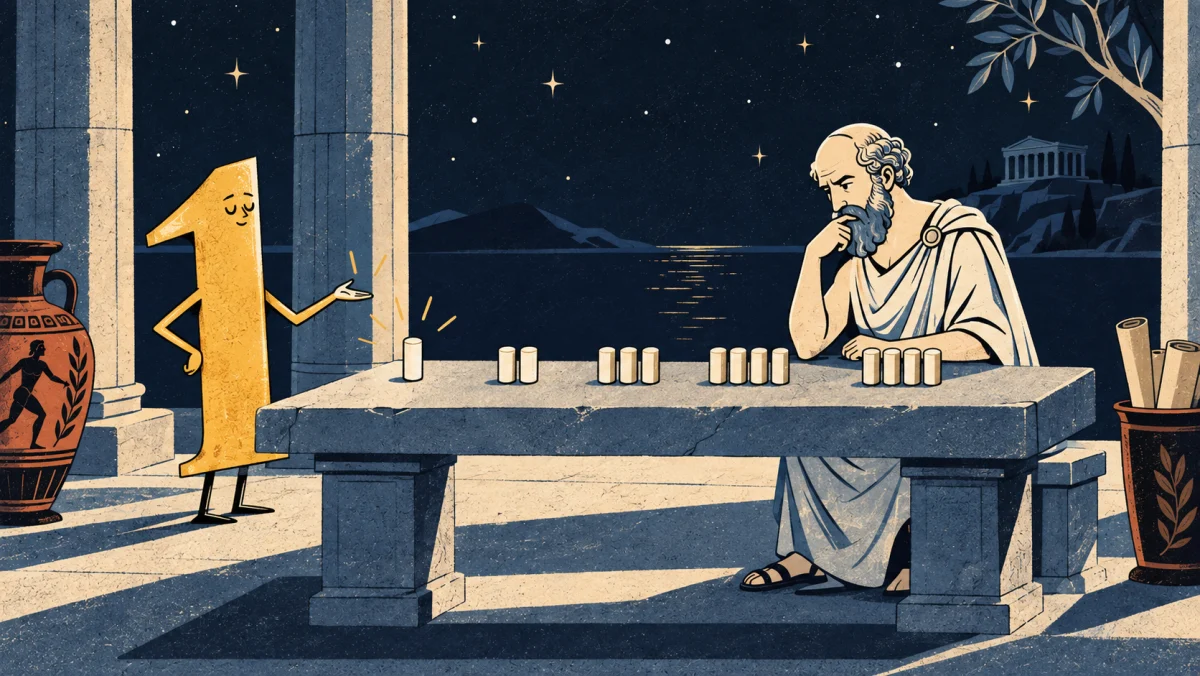
If we climbed into a time machine, abducted a mathematician from ancient Greece, and asked them to count, they would most likely begin with . If, by chance, our pointless—and probably illegal—endeavour happened to land us a mystical Pythagorean, they might even begin with
The simplest explanation would be that ancient Greek mathematicians did not know how to count. In fact, they merely did not regard —and occasionally —as a number. The reason was that what came to their minds when they heard the word “number” was not quite what comes to ours.
Ancient Greek mathematicians viewed as the unit from which all other numbers arose. They understood 3, for instance, as three units. Naturally, they were not about to commit the absurdity (!) of treating the very unit used to “measure” numbers as a number itself. Numbers were not independent objects in the modern sense; they came into being through a multiplicity of units.
In the Elements, Euclid defined them as follows:
A unit is that by virtue of which each of the things that exist is called one.
A number is a multitude composed of units.
One group among the Pythagoreans—one of the more fashionable sects of the period—took matters even further. To them, numbers were not merely tools for counting but the building blocks of the universe, carrying geometric and philosophical meanings as well. While represented unity, wholeness, sameness, and light, marked the beginning of opposition, difference, and darkness. With came, for the first time, a beginning, a middle, and an end—as well as the triangle, the first plane figure that could be enclosed by points. In some Pythagorean traditions, this gave a special status as the first true number.
Having defined number, Euclid also offered a definition of a prime:
A prime number is that which is measured by a unit alone.
Euclid used the idea of “measuring” rather than division. For one number to measure another meant that repeating the measuring number some whole number of times produced the measured number exactly. By this account, a prime could be measured only by the unit.
An attentive reader may object that every prime also measures itself—and they would be entirely right. Euclid does not explicitly discuss self-measurement in this definition, although elsewhere in the Elements he does say that a number measures itself. Perhaps “measuring” here was intended to refer only to numbers smaller than the number being measured. Otherwise, we may have to conclude that Euclid wrote this definition at five o’clock on a Friday afternoon.
Euclid also proved that a prime number must satisfy the following rule:
If is prime and divides the product , then divides at least one of the factors, either or .
For example, the prime divides , and it also divides one of the factors, namely . This is no coincidence: whenever divides the product of two integers, it must divide at least one of them.
The non-prime number does not have this property. It divides yet it divides neither factor.
Returning to our main subject, asking whether itself was prime would have been meaningless in ancient Greece. It failed the most basic requirement for being prime: it was not even a number. Before it could approach the door of the aristocrats’ club, it first had to move up in the world.
That promotion would take centuries.
A Growing Number Family Gets a New One
Years passed, the world changed, one mathematician died and another was born, and the number family continued to expand. Fractions had long been known alongside the integers. Legend even has it that the Pythagoreans drowned a member of their sect for revealing the secret of the irrational number . Between the fifth and seventh centuries, Indian mathematicians worked with and negative numbers; Brahmagupta gave rules for calculating with positive numbers, negative numbers, and zero. Mathematicians in the Islamic world later helped spread the Indian numeral system across the globe.
Apparently this was still not enough numbers. By the sixteenth century, Cardano and Bombelli noticed the mysterious quantity appearing in their calculations for the roots of certain cubic equations, producing the solution and then vanishing again. In the seventeenth century, Descartes—who did not regard these quantities as “real”—gave them the somewhat dismissive name imaginary numbers (nombres imaginaires). The we meet in school when learning complex numbers still echoes that name.
The concept of number was gradually changing from a geometric multitude into an object with which one could calculate. In such an expanding family, the continued exclusion of inevitably became a matter of debate. The mathematician who did the most to raise its status was Simon Stevin. With a remarkably inclusive and democratic spirit, he explicitly treated , along with negative, irrational, radical, and fractional quantities, as numbers no different in principle from the rest. His argument proved highly successful.
The number had finally come of age. But could it become prime?
To Be Prime or Not to Be
When Euclid defined prime numbers, the only barrier standing before was that it was not a number. Now that obstacle had disappeared, and had reached the threshold of primality. On paper, it looked like the perfect candidate.
Indeed, some mathematicians included among the primes. Others continued the Euclidean habit of beginning the list with . For a long time there was no universal rule. In one book was prime; in another it was not. Frankly, mathematicians did not care all that much. Some even treated as prime on one page and began their list of primes with on another. Either convention could be made to work without changing very much in their calculations or definitions.
The Fundamental Theorem of Arithmetic
In his 1801 Disquisitiones Arithmeticae, Gauss placed prime factorisation at the centre of number theory. The result we now call the Fundamental Theorem of Arithmetic says that every integer greater than can be expressed as a product of primes in essentially one way, apart from the order of the factors. To choose an entirely random example, can be written as .
If is declared prime, however, the phrase “one way” begins to cause trouble.
The easiest solution would simply be to restate Gauss’s theorem as a product of “primes other than ,” or otherwise specify the role of carefully enough to preserve uniqueness.
The Fundamental Theorem of Arithmetic is commonly offered as the reason is not prime. Yet, as we have just seen, the inconvenience caused by allowing among the primes can be removed with one small condition. We cannot really accuse Gauss of expelling from the club with the theorem alone. He would do it instead by opening the door to entirely different number systems, including the Gaussian integers.
One Has a Place of Its Own
The Gaussian integers are numbers of the form , where and are integers. Once such numbers enter the picture, the questions multiply. If an integer such as is prime, is prime as well? What about ? And can we call prime?
The Gaussian integers were only one example among many new number systems mathematicians began to study. Discovering that these systems contained other elements resembling created a need for a more general definition of primality.
Before reaching that modern definition, mathematicians identified several kinds of elements that may occur in a number system:
- An identity element leaves another number unchanged under a given operation. Multiplying any number by , for example, does not change it. If a number system has an identity element for a particular operation, it can have only one.
- A unit is an element that divides the multiplicative identity. The units among the integers are . In the Gaussian integers, remembering that , the units are .
Defining prime elements in this broader setting proved more demanding. Two properties that always appear together among the integers—and therefore seem identical there—can separate in other number systems.
Let us build an example step by step:
- Let and be integers and consider the number system .
- Its multiplicative identity is .
- Its units are .
- The number belongs to this system because and are integers, and we may write .
- Following the older, Euclidean-style criterion, appears prime because it can be measured only by units.1
- If Euclid’s proposition about primes also holds in this system, then whenever divides a product, it must divide at least one of the factors.
- We have .
- The number divides .
- Yet divides neither nor .
- Therefore fails Euclid’s property for primes and is not prime in this system.
Here, the two tests used in steps 5 and 10 come apart. Euclid’s proposition holds for primes among the integers, but it does not automatically remain true when we move beyond the integers. The need to distinguish these two properties—and to formulate a modern definition of prime elements—had become impossible to ignore.
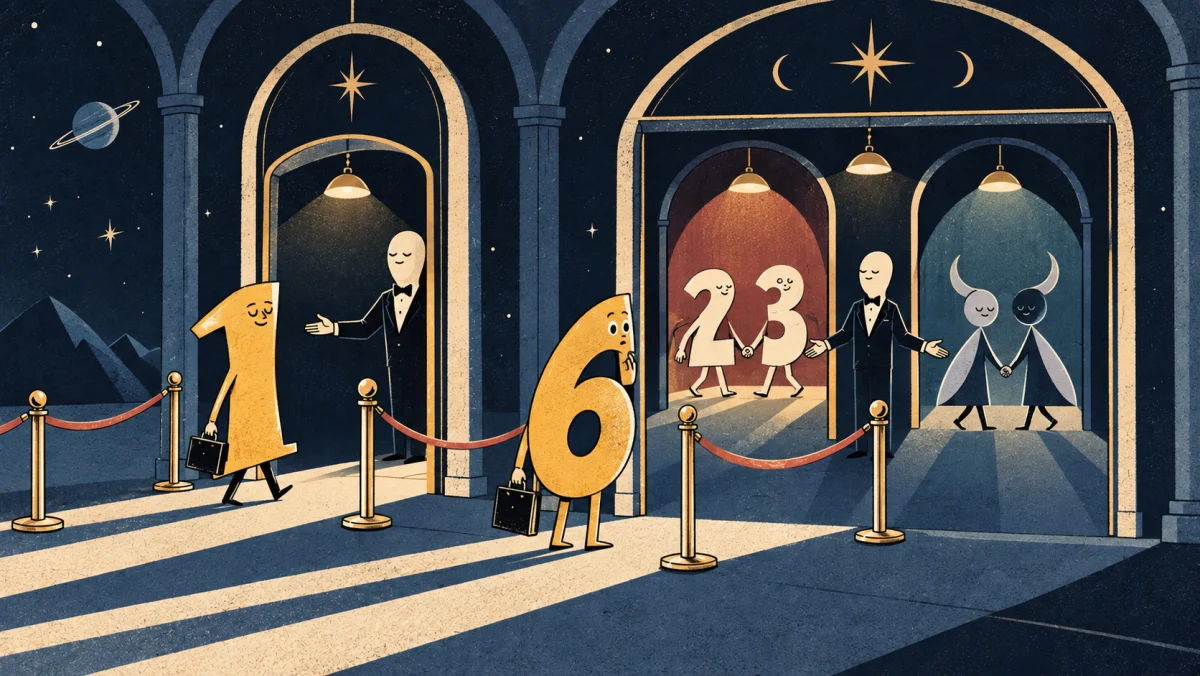
The definition eventually chosen for prime elements was not unfamiliar at all: it was the very property Euclid had proved about primes. The older test became the definition of an irreducible element:
- A nonzero, non-unit element is called prime if, whenever it divides a product , it divides at least one of or .
- A nonzero, non-unit element is called irreducible if, in every factorisation , at least one of or is a unit.
Under the modern definition, the requirement that a prime element must not be a unit is stated explicitly. The two-thousand-year story of thus ended with a loophole in the primes’ club rules being closed against it. Still, was not sent away empty-handed: together with the other units it had met along the way, it was given a new club of its own.
The History Behind the Obvious
When I began writing about this subject, I thought: how difficult could it be to explain why is not prime? I had overlooked the fact that behind every accepted truth in mathematics, however small, lies an immense history of assumptions, mistakes, discoveries, and contradictions. Before writing this article, I did not even know that had once not been considered a number. What now feels like knowledge we were born with was far from obvious to people in the ancient world. Within their own intellectual framework, ancient mathematicians had built an entirely reasonable system.
These historical changes also reveal how mathematical thought transforms across centuries. Who knows which of our own settled beliefs and assumptions will be questioned two thousand years from now?
References
- Euclid’s *Elements*, translated into Turkish by Ali Sinan Sertöz
- Why 1 Isn't A Prime Number
- Caldwell, Chris K. and Yeng Xiong. “What is the Smallest Prime.” arXiv: History and Overview (2012): n. pag.
- Reddick, A., & Xiong, Y. (2012). The Search for One as a Prime Number: From Ancient Greece To Modern Times.
- David Pierce, *Elementary Number Theory*, “Prime Numbers”, p. 51
Comments
Your turn
If something stayed with you, raised a question, or deserves another angle, you can leave it here.
Name and email are required to comment. Your email address will not be shown on the site.